For millennia, the Indian Ocean has been the world’s most sophisticated laboratory of globalization. Long before the Atlantic became a highway for empires or the Pacific a theater for world wars, the “Monsoon Trade” had already stitched together a world of African gold, Arabian incense, Indian spices, and Chinese silk. Today, the maritime rivalries between India, China, and the West are often framed as “new” developments. In reality, they are the latest chapters in a deep-time struggle to control the same choke points and trade veins that defined the Cholas, the Portuguese, and the British. To understand the 2026 security architecture of the Indian Ocean, one must first understand the ghosts that haunt its waters.
Read here “why the Indian Ocean remains the central arena of global trade, energy flows, and strategic competition”
I. The “Monsoon Commons”: A Pre-Colonial Order (3000 BCE – 1500 CE)
Before the arrival of European “Man-of-War” ships, the Indian Ocean operated under a remarkably stable, indigenous maritime order. This was not an ocean of borders, but an ocean of networks.
The regulator of this system was not a king or an admiral, but the Monsoon. The seasonal reversal of winds—blowing from the southwest in summer and the northeast in winter—dictated the rhythm of civilization.
- The Shared System: This was a “low-friction” environment. Merchants from the Swahili coast, the Hadramaut, the Malabar coast, and the Malay Peninsula shared the waters using the Dhow, a vessel that represented the pinnacle of 1st-millennium maritime engineering.
- The Chola Hegemony: The 11th-century Chola Empire of South India provides the most direct historical parallel to modern India’s “Security and Growth for All in the Region” (SAGAR) vision. Under Rajendra Chola I, the Chola Navy was a projection force that launched massive expeditions across the Bay of Bengal to secure the Malacca Strait against the Srivijaya Empire. The Cholas didn’t seek to occupy land; they sought to secure the SLOCs (Sea Lines of Communication) of their era.
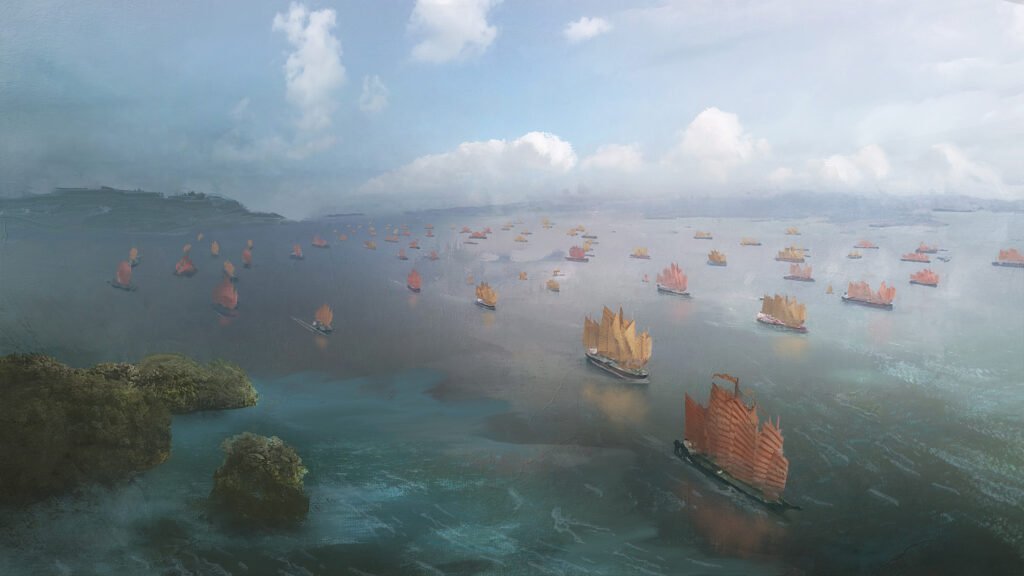
- The Zheng He Interlude: Between 1405 and 1433, the Chinese Ming Dynasty’s “Treasure Fleets” under Admiral Zheng He dominated the IOR. This era is frequently cited today by Beijing to justify its “natural” presence in the region, portraying Zheng He as a “diplomat of peace” compared to European conquerors.
II. 1498: The Break of the Sea and the Invention of Armed Trade
The arrival of Vasco da Gama at Calicut in 1498 was not just a navigational feat; it was a geopolitical rupture. For the first time, a power arrived that viewed trade not as a shared activity, but as a monopoly to be enforced by violence.
The Portuguese introduced the Cartaz system—a mandatory safe-conduct pass for all merchant vessels. If a dhow was caught without a Portuguese cartaz, its cargo was seized and its crew often executed.
- The Lesson for 2026: This was the birth of “Armed Trade.” The Portuguese realized they didn’t need to control the entire ocean; they only needed to control the choke points. They seized Hormuz, Goa, Malacca, and attempted to take Aden.
- Modern Echo: When analysts look at China’s “String of Pearls” or India’s “Necklace of Diamonds” today, they are seeing a digital-age version of the Portuguese Estado da Índia—a strategy based on controlling critical “nodes” rather than vast stretches of open water.
III. Pax Britannica and the “British Lake” (1815–1947)
By the 19th century, the British Royal Navy had effectively turned the Indian Ocean into a “British Lake.” This era created the institutional and geographic architecture we still use today.
The British consolidated the “Triple Crown” of maritime control: Singapore in the east, Aden in the west, and Colombo at the center.
- Choke Point Institutionalization: The British didn’t just guard the gates; they built the infrastructure (telegraph cables, coaling stations) that made the gates vital.
- The Legal Framework: The concept of “freedom of navigation” was championed by the British primarily because it suited the world’s largest merchant fleet.
- The Great Game: The 19th-century competition between the British and Russian Empires over the “warm water ports” of the Indian Ocean is the direct ancestor of today’s US-China competition.
IV. The Cold War and the Disputed Peace (1947–1991)
The decolonization of the 1950s and 60s left a “power vacuum” that the Superpowers were eager to fill. This era introduced the militarization of islands that remains a primary flashpoint in 2026.
- The Chagos Dispute: In the 1960s, the UK detached the Chagos Archipelago from Mauritius to lease Diego Garcia to the US for a military base. To this day, the dispute over Chagos remains a symbol of “unfinished decolonization” and a thorn in the side of US-Mauritius relations.
- The Zone of Peace (ZOP): In 1971, Sri Lanka and India proposed the “Indian Ocean as a Zone of Peace” at the UN, attempting to keep the Cold War out of their waters. The failure of the ZOP resolution showed that as long as the Indian Ocean is the world’s “connector,” external powers will never leave it alone.
V. 2026: History as a Strategic Compass
As we navigate the complexities of 2026, the patterns of history are repeating with uncanny precision.
- The Return of the “Station” Wars: Just as the Portuguese and British raced for coaling stations, today’s powers are racing for Logistics Support Agreements. China’s base in Djibouti and India’s access to Duqm (Oman) and Agaléga (Mauritius) are the 21st-century versions of the 19th-century coaling stations.
- Technological Repercussions: In the 1500s, it was the cannon-decked nao that changed the game. In 2026, it is the unmanned maritime drone and the hypersonic anti-ship missile. These technologies are once again making the “low-friction” trade of the pre-colonial era impossible, as non-state actors (like the Houthis in the Red Sea) can now challenge major navies using asymmetric tools.
- The “Chakravyuha” Doctrine: India’s 2025/26 shift toward a “layered” maritime defense—drawing on the ancient Chakravyuha formation from the Mahabharata—is a fascinating example of a “civilizational state” using its deepest history to frame its most modern strategic challenges.
VI. Conclusion: The Forward-Looking Mirror
The history of the Indian Ocean teaches us one primary lesson: Stability in this region is the exception, not the rule. The “Quiet Center” of the 1990s and early 2000s was a historical anomaly created by U.S. unipolarity.
In 2026, we are returning to the “normal” state of the Indian Ocean—a multipolar, high-stakes environment where trade and security are inseparable. The actors have changed—from the VOC and the Cholas to the PLA Navy and the Indian Navy—but the geography remains the same. The one who understands the history of the currents will be the one best prepared to weather the storms of 2026.
Pingback: Indian Ocean Chokepoints Explained: Seven Passages That Matter