
In the age of satellite warfare and cyber-espionage, the global economy remains tethered to the physical world by seven narrow maritime “throats.” These chokepoints—some no wider than a city park—are the jugular veins of the Indian Ocean Region (IOR). As 2025 demonstrated, a single disruption at these points does not merely delay cargo; it re-prices global energy, rewrites insurance laws, and forces great powers into impossible choices. This briefing examines the seven passages that define the strategic limits of the 21st century.
Read our explainer on geopolitical significance of Indian Ocean Region
The Chokepoint Paradox: Control vs. Disruption
In 2026, we have entered the era of the Chokepoint Paradox: it has never been harder to “control” a maritime passage, yet it has never been easier to “disrupt” one. Traditional naval dominance—defined by carrier strike groups and massive surface fleets—is increasingly vulnerable to the “democratization of precision strike.” When a non-state actor with a $20,000 drone can threaten a $2 billion destroyer, the strategic leverage shifts from the one who guards the gate to the one who can threaten it.
1. The Strait of Hormuz: The Energy Veto
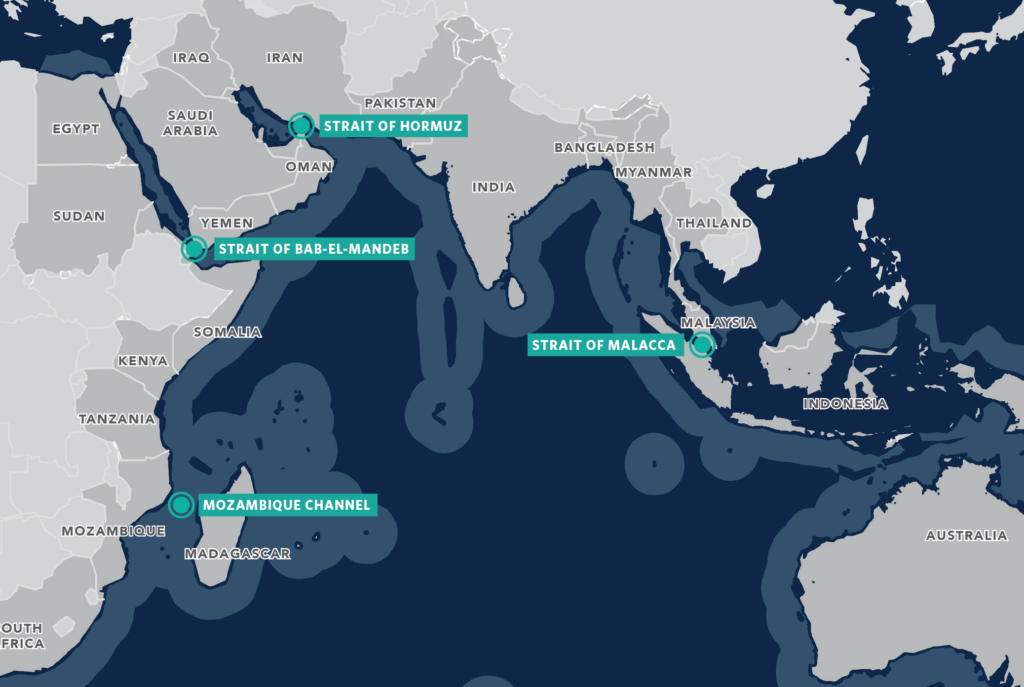
The Strait of Hormuz remains the world’s most critical energy artery. With roughly one-fifth of the world’s daily oil consumption passing through its 21-mile width, it is the ultimate geopolitical “kill switch.”
- The Leverage: Iran’s proximity to the strait gives it a “veto power” over global energy markets. Even the threat of closure in 2025 sent Brent crude prices spiking by 15% in a single afternoon.
- The 2026 Reality: While the U.S. and its partners maintain a heavy presence, the introduction of “smart mines” and semi-submersible drone swarms has made traditional minesweeping operations a high-risk, slow-moving endeavor.
2. Bab el-Mandeb: The Asymmetric Nightmare
Connecting the Red Sea to the Gulf of Aden, the “Gate of Grief” has lived up to its name. The 2024–2025 Houthi campaign transformed this passage into a laboratory for asymmetric warfare.
- The Leverage: It serves as the southern plug to the Suez Canal. By disrupting Bab el-Mandeb, actors can effectively “close” the Suez without ever firing a shot near Egypt.
- The Pricing Effect: In 2025, maritime insurance “war risk” premiums for Red Sea transits increased by 900%, forcing nearly 80% of container traffic to take the 4,000-mile detour around Africa.
3. The Strait of Malacca: The Economic Heartbeat
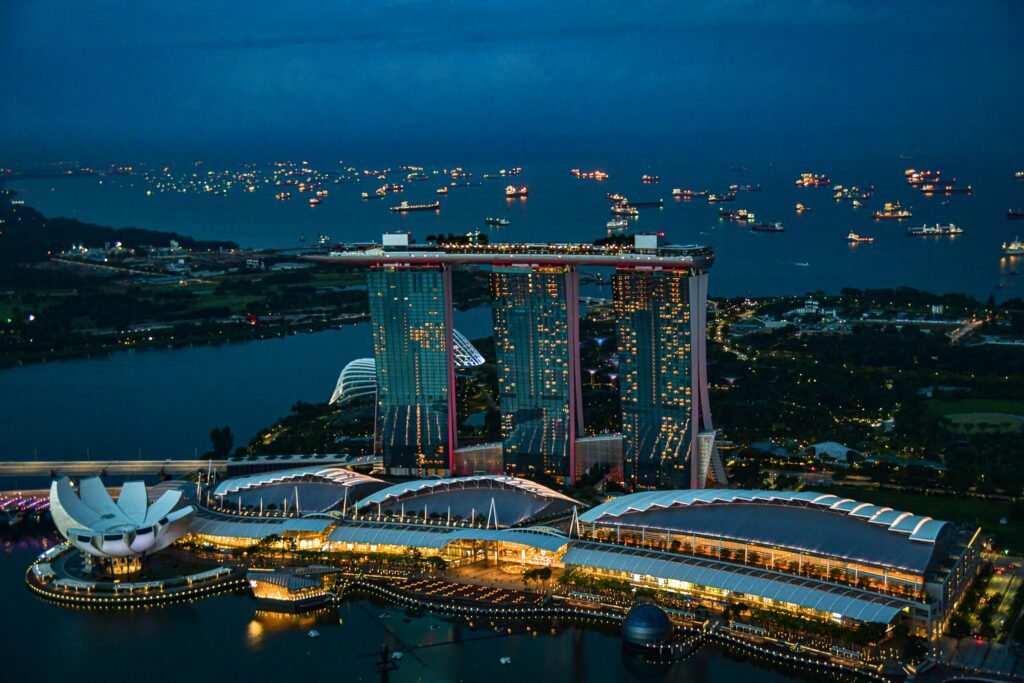
The shortest sea route between the Middle East and East Asia, Malacca is the primary focus of China’s “Malacca Dilemma.”
- The Leverage: Over 100,000 vessels pass through here annually. If the strait were blocked, global shipping capacity would immediately contract by 25% due to the longer voyage times required for rerouting.
- The Vulnerability: Its narrowest point, the Phillips Channel, is only 1.5 miles wide. A single scuttled tanker or a large-scale cyber-spoofing of GPS signals could create a “maritime pile-up” that takes weeks to clear.
4. The Suez Linkage: The Global Pulse
While technically a canal, the Suez-Red Sea corridor functions as a single strategic passage.
- The Leverage: It is the primary connector between the IOR and the European market.
- The Lesson: The “Ever Given” incident was a warning; the 2025 missile strikes were the reality. The leverage here is time. In a “just-in-time” global economy, the 10-day delay caused by bypassing Suez is enough to trigger manufacturing shutdowns in Germany and food inflation in the Levant.
5. Lombok Strait: The Deep-Water Shadow
As Malacca becomes more congested and contested, the Lombok Strait (between Bali and Lombok) has emerged as the “silent alternative.”
- The Leverage: Unlike the shallow Malacca, Lombok is deep and wide. It is the preferred route for Ultra-Large Crude Carriers (ULCCs) and, crucially, for submerged nuclear submarines moving between the Pacific and Indian Oceans.
- The AUKUS Factor: In 2026, the monitoring of the Lombok Strait has become a top priority for the AUKUS alliance, as it represents the primary “sally port” for Chinese submarines entering the deep waters of the IOR.
6. The Mozambique Channel: The Gas Corridor
Once a backwater, the 1,000-mile-long channel between Madagascar and Mozambique is now the “Frontier of Energy.”
- The Leverage: Following the discovery of massive offshore gas reserves and the ongoing insurgency in Cabo Delgado, the channel has become a focal point for French, Indian, and Rwandan security interests.
- The Risk: It is a primary transit point for energy heading to the Cape of Good Hope. Instability here threatens the “Southern Bypass” that the world relies on when the Red Sea is closed.

7. Sunda Strait: The Archipelagic Bypass
Located between Java and Sumatra, the Sunda Strait is the secondary gateway to the Indian Ocean from the north.
- The Leverage: It is a vital alternate for ships heading from East Asia to the African coast.
- The Strategic Trap: While it offers a bypass to Malacca, it is notoriously difficult to navigate due to strong currents and volcanic activity (Krakatoa). Its “leverage” is primarily as a fallback—if it is also disrupted, the Indo-Pacific effectively splits in two.
The Economic Physics of a Choke: Why Navies Can’t Save You
In 2026, the strategic community has realized that “keeping the lanes open” is no longer enough. Even if a navy can technically escort a ship through a strait, the economic cost of the escort may still break the system.
- The Insurance Weapon: Maritime insurers (Lloyd’s, etc.) have become “geopolitical actors.” If they refuse to cover a passage, the passage is effectively closed to commercial trade, regardless of what the Navy says.
- Gray-Zone Saturation: Navies are designed to fight other navies. They are not equipped to intercept 500 low-cost “suicide dhows” or identify a “civilian” vessel laying smart mines.
- The Infrastructure Lag: We are still using 20th-century ports to handle 21st-century shocks. When a chokepoint is pinched, the surge of rerouted ships causes “port constipation” in places like Colombo, Salalah, and Cape Town, leading to a secondary economic crisis.
Pingback: Why the World Is Focused on the Indian Ocean in 2026
Pingback: Why Sri Lanka Is Strategically Important in the Indian Ocean
Pingback: Middle East War Triggers Indian Ocean Crisis